لطفا منتظر بمانید ...
0% Complete
English
☰
صفحه اصلی
کنفرانسهای فعال
مدیریت منابع انسانی پایدار
حسابداری
بازاریابی و برندینگ در عصر هوش مصنوعی
هوش مصنوعی:نوآوری، کسبوکار و آموزش
ارشیو کنفرانسها
اولین کنفرانس ملی هوش مصنوعی
دومین کنفرانس ملی هوش مصنوعی
اولین کنگره ملی حسابداری، مالی و مالیاتی
32کنفرانس بین المللی زیست پزشکی
راهنمای شرکت
نحوه ثبتنام
ثبت نام مدیریت منابع انسانی پایدار
ثبت نام دومین کنگره ملی حسابداری
ثبت نام سومین کنفرانس ملی هوش مصنوعی
ثیت نام بازاریابی و برندینگ در عصر هوش مصنوعی
ثبت نام زنجیره ارزش نفت گاز و پتروشیمی
ارسال مقاله
فرمت مقالات مدیریت منابع انسانی پایدار
فرمت مقالات سیستم های هوشمند حسابداری
فرمت مقالات ملی بازاریابی و برندینگ در عصر هوش مصنوعی
فرمت مقالات سومین کنفرانس هوش مصنوعی
سوالات متداول
اخبار و رویدادها
درباره ما
تماس با ما
صفحه اصلی
/
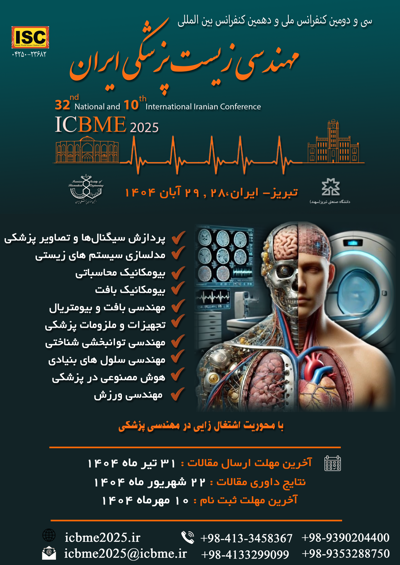
سی و دومین کنفرانس ملی و دهمین کنفرانس بین المللی مهندسی زیست پزشکی ایران
Biomechanical Contrast Between Native and Decellularized Triple-Negative Breast Tumors in Mice
نویسندگان :
Mohammad Javad Farjam
1
Saman Asadi
2
Ashkan Azimzadeh
3
Saeid Amanpour
4
AbdolMohammad Kajbafzadeh
5
Mohammad Ali Nazari
6
1- دانشگاه تهران
2- دانشگاه علوم پزشکی تهران
3- دانشگاه علوم پزشکی تهران
4- دانشگاه علوم پزشکی تهران
5- دانشگاه علوم پزشکی تهران
6- دانشگاه تهران
کلمات کلیدی :
4T1 tumor،(triple-negative breast cancer (TNBC،decellularization،(extracellular matrix (ECM،atomic force microscopy (AFM)،tissue stiffness،tumor microenvironment
چکیده :
Triple-negative breast cancer (TNBC) is an aggressive subtype that does not have any targeted receptor-based therapies available, for which the 4T1 cell line–based murine model hosted in BALB/c (“Bagg Albino”) mice offers a viable syngeneic model. In this work, we provided a comparative assessment of the structural and mechanical properties of native and decellularized tumors induced by the 4T1 cell line (hereafter referred to as 4T1 tumors). Hematoxylin and eosin (H&E) images visually confirmed successful removal of nuclear content with maintenance of the architecture of the cross-linking throughout the extracellular matrix (ECM). Scanning electron microscopy (SEM) displayed hierarchical ultrastructure, with fibrous and porous morphology preserved after decellularization. Atomic force microscopy (AFM) nano-indentation testing illustrated a significant reduction in stiffness following decellularization: the native 4T1 tumor exhibited a mean Young’s modulus of 71.3 ± 19.7 kPa, whereas the decellularized ECM measured 10.5 ± 8.6 kPa. This ~7-fold decrease highlights the role of cellular components in conferring tumor rigidity while confirming the preservation of ECM scaffolds. The normality test (Lilliefors) showed p = 0.0181 for native tumor samples and p = 0.0010 for decellularized samples, indicating that data may not be normally distributed (p < 0.05). AFM indentation was performed using a quadratic pyramid probe. Tumors were generated in 8 BALB/c mice, of which 4 samples were subsequently decellularized for analysis. These findings validate the feasibility of decellularized 4T1 tumors as biomimetic scaffolds for studying tumor–stroma interactions, mechanobiology, and therapeutic modeling.
لیست مقالات
لیست مقالات بایگانی شده
Gene expression changes induced by Atorvastatin in breast cancer and stem cells
Seyed Mahdi Mousavi - Yaghub Pazhang
نقش حسابداری مدیریت در استراتژی فرهنگ سازمانی و مالیاتی
علی نمازیان - حمیدرضا فیروزآبادی
Attentive Temporal Fusion Network (ATFNet) for Multi-frame Coronary Vessel Segmentation in X-ray Angiography
Pouya Babaei - Farshad Almasganj
Evaluation and Comparison of Columnar Databases Cassandra, Kudu, HBase, Google Bigtable, MariaDB, and Greenplum for Fast and Accurate Data Processing
Sareh Gorgbandi - Nafiseh Osati
ارتباط بین عملکرد پایداری و سرمایه گذاری بیشتر و کمتر از حد
سعید انور خطیبی - علی زارع بهتاشی
Application of Nanomaterials in Biomaterials for the Regeneration of Bone and Cartilage Tissues
Behnaz Alijani - Niloufar Kazami
Curcumin-Loaded Carboxymethyl Cellulose/Polyvinyl Alcohol Smart Wound Dressing: A Biosensor Approach for pH-Responsive Monitoring and Healing
Saeid Orangi - Soodabeh Davaran
Accurate Brain Vessel Segmentation in T1-Weighted MRI based on UNETR: Improving Neurosurgical Planning
Fatemeh Gholizadeh - Mahdiyeh Rahmani - Ahmad Pour-Rashidi - Ebrahim Najafzadeh - Parastoo Farnia - Alireza Ahmadian
بررسی نقش میانجی هوش مصنوعی در تاثیر استراتژی های شرکت و استراتژی های رقابتی بر عملکرد شرکت (مطالعه موردی: شرکتهای دانش بنیان فناوری مالی در پارک فناوری پردیس تهران)
نادیاالسادات حسینی
ارزیابی تأثیر حسابداری مدیریت بر افزایش سرمایه فکری سازمانهای دولتی کشور
حسین بوذری
بیشتر
19 اردیبهشت 1405
راهنمای انتخاب کنفرانس معتبر برای چاپ مقاله علمی
19 اردیبهشت 1405
چرا شرکت در کنفرانسهای علمی برای مصاحبه دکتری اهمیت دارد؟
21 اردیبهشت 1405
پذیرش سریع مقاله در کنفرانسهای علمی مهندسی و فناوری آغاز شد
21 اردیبهشت 1405
آغاز ثبتنام در همایشهای بینالمللی مدیریت و حسابداری
ثمین همایش، سامانه مدیریت کنفرانس ها و جشنواره ها - نگارش 44.7.0