لطفا منتظر بمانید ...
0% Complete
English
☰
صفحه اصلی
کنفرانسهای فعال
مدیریت منابع انسانی پایدار
حسابداری
بازاریابی و برندینگ در عصر هوش مصنوعی
هوش مصنوعی:نوآوری، کسبوکار و آموزش
ارشیو کنفرانسها
اولین کنفرانس ملی هوش مصنوعی
دومین کنفرانس ملی هوش مصنوعی
اولین کنگره ملی حسابداری، مالی و مالیاتی
32کنفرانس بین المللی زیست پزشکی
راهنمای شرکت
نحوه ثبتنام
ثبت نام مدیریت منابع انسانی پایدار
ثبت نام دومین کنگره ملی حسابداری
ثبت نام سومین کنفرانس ملی هوش مصنوعی
ثیت نام بازاریابی و برندینگ در عصر هوش مصنوعی
ثبت نام زنجیره ارزش نفت گاز و پتروشیمی
ارسال مقاله
فرمت مقالات مدیریت منابع انسانی پایدار
فرمت مقالات سیستم های هوشمند حسابداری
فرمت مقالات ملی بازاریابی و برندینگ در عصر هوش مصنوعی
فرمت مقالات سومین کنفرانس هوش مصنوعی
سوالات متداول
اخبار و رویدادها
درباره ما
تماس با ما
صفحه اصلی
/
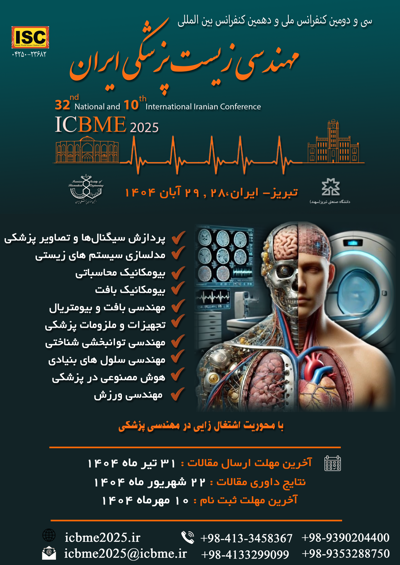
سی و دومین کنفرانس ملی و دهمین کنفرانس بین المللی مهندسی زیست پزشکی ایران
Improving Generalization in MRI-Based Deep Learning Models for Total Knee Replacement Prediction
نویسندگان :
Ehsan Karami
1
Hamid Soltanian-Zadeh
2
1- School of Electrical and Computer Engineering, College of Engineering, University of Tehran Tehran, Iran
2- School of Electrical and Computer Engineering, College of Engineering, University of Tehran Tehran, Iran
کلمات کلیدی :
knee osteoarthritis،deep learning،medical image analysis،MRI،total knee replacement prediction،model generalization
چکیده :
Knee osteoarthritis (KOA) is a common joint disease that causes pain and mobility issues. While MRI-based deep learning models have demonstrated superior performance in predicting total knee replacement (TKR) and disease progression, their generalizability remains challenging, particularly when applied to imaging data from different sources. In this study, we show that replacing batch normalization with instance normalization, using data augmentation, and applying contrastive loss improves generalization. For training and evaluation, we used MRI data from the Osteoarthritis Initiative (OAI) database, considering sagittal fat-suppressed intermediate-weighted turbo spin-echo (FS-IW-TSE) images as the source domain and sagittal fat-suppressed three-dimensional (3D) dual-echo in steady state (DESS) images as the target domain. The results demonstrated a statistically significant improvement in classification metrics across both domains by replacing batch normalization with instance normalization in the baseline model, generating augmented input views using the Global Intensity Non-linear (GIN) augmentation method, and incorporating a supervised contrastive loss alongside the classification loss to align representations of samples with the same label. In the source domain, this approach achieved an accuracy of 74.12 ± 2.90, an F1 score of 74.57 ± 3.33, and a ROC AUC of 80.65 ± 2.83, outperforming the baseline model, which scored 71.29 ± 4.43, 69.76 ± 4.58, and 77.79 ± 4.66, respectively. In the target domain, the method achieved an accuracy of 70.04 ± 2.49, F1 score of 67.30 ± 3.57, and ROC AUC of 78.12 ± 1.97, compared to the baseline’s 52.87 ± 3.17, 18.98 ± 16.89, and 59.33 ± 6.20. The GIN method with contrastive loss performed better than all evaluated single-source domain generalization methods when using 3D instance normalization. Comparing GIN with and without contrastive loss (for both normalization types) showed that adding contrastive loss consistently led to better performance.
لیست مقالات
لیست مقالات بایگانی شده
Electrochemical Biosensors Based on Polyaniline Nanostructures: An Analysis of Advances, Performance Challenges, and the Outlook for Smart Systems
Nasim Kharazminezhad - Ramez Pourahmad
Ethical Challenges in the Use of Artificial Intelligence: Risks, Frameworks, and Responsible Innovation
Seyed Javad Roudehchi Tabrizi - Samar Goldouz
بررسی عملکرد سلولهای T در میکرومحیط تومور HGSOC با رویکرد توالییابی تکسلولی
زهرا زندی - روزبه عابدینی نسب
بررسی تاثیر معیارهای قرارداد هوشمند بر عملکرد فناوری بلاکچین
محمد علیمحمدی - امیر نجفی
Optimal Control and Emergence of Kinematic Synergies in Underactuated Biped Locomotion
Mahdi Alipoor - Masoud Yousefi - Farzam Farahmand
Accelerated Diffusion-Weighted Imaging via Diffusion Gradient Alternation in Radial k-Space Sampling
Fateme Hoseini Rashkani - Abbas Nasiraei Moghaddam
Unsupervised Gait Anomaly Detection Using Generative Adversarial Networks: A Feasibility Study
Seyed Hooman Hosseini-Zahraei - Ali Chaibakhsh
بهبود تخمین ضربان قلب در دستگاههای پوشیدنی تجاری با استفاده از فیلتر کالمن و مدلهای رگرسیون
میلاد رضایی ارجمند - تانیا حسین خانی - امیرحسین تجرد - علیرضا طالش جفادیده - اصغر زارعی
مروری بر کاربرد هوش مصنوعی در شبکه های اجتماعی، فرصتها و چالش ها
سیدمحمد بیدکی - رضا آذربان - فاطمه بشارتی
Structural Insights into the Molecular Mechanism of Cancer Regulator BRCA1 Methylation
Shadi Asadi - Maryam Azimzadeh Irani
بیشتر
19 اردیبهشت 1405
راهنمای انتخاب کنفرانس معتبر برای چاپ مقاله علمی
19 اردیبهشت 1405
چرا شرکت در کنفرانسهای علمی برای مصاحبه دکتری اهمیت دارد؟
21 اردیبهشت 1405
پذیرش سریع مقاله در کنفرانسهای علمی مهندسی و فناوری آغاز شد
21 اردیبهشت 1405
آغاز ثبتنام در همایشهای بینالمللی مدیریت و حسابداری
ثمین همایش، سامانه مدیریت کنفرانس ها و جشنواره ها - نگارش 44.7.0